

When people ask how close a window can be to a corner, they are usually trying to solve two problems at once.
They want more glass, more light, and cleaner sightlines. But they also need the wall to keep doing its job.
The closer a window moves to the edge of a building, the more important structure becomes. What looks like a simple layout decision quickly turns into a question about framing, load paths, lateral resistance, waterproofing, and code review.
The short answer is this: there is no universal minimum distance that applies to every project.
A window can sometimes be placed very close to a corner, but the allowable distance depends on whether the wall is load-bearing, what loads are above, how the corner is framed, what the local code requires, and whether the design uses a conventional window assembly or a purpose-built structural corner system.
For architects, builders, and homeowners, that distinction matters.
In a traditional wall, the corner does more than define the edge of the room. It helps tie walls together, carry vertical loads, and resist wind or seismic forces.
That is why pushing glass toward the corner often creates structural limits. It is also why modern load-bearing corner window systems have become such a compelling design solution.
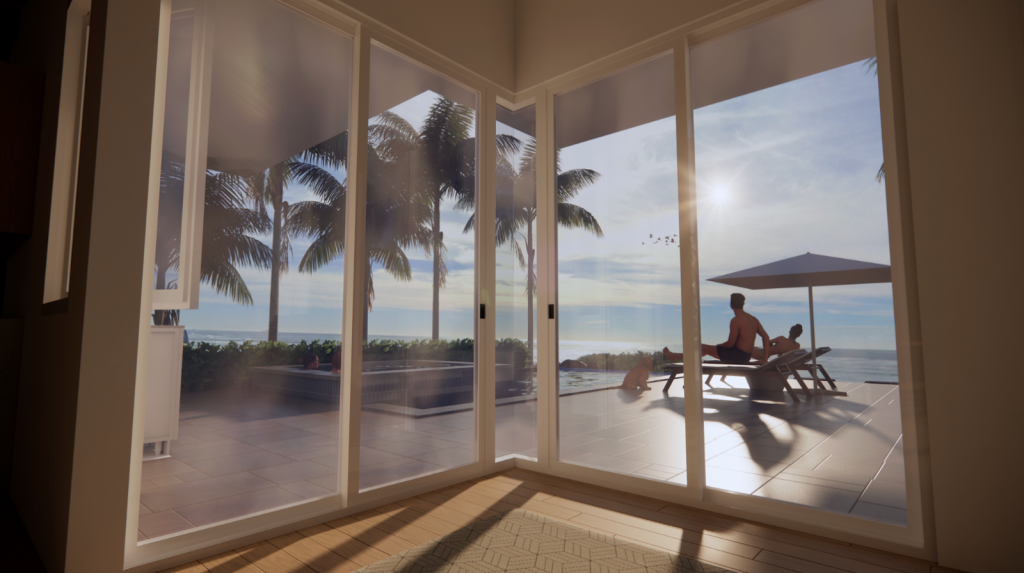
TonyView is built around that exact challenge: removing the visual obstruction of the corner while maintaining the structural integrity the building still needs.
What does “how close can a window be to a corner” actually mean?
This question sounds simple, but it can mean a few different things in practice.
Sometimes the question is about the rough opening. A builder wants to know how much framed wall must remain between the exterior corner and the start of the opening.
Sometimes it is about the finished window frame. An architect may be asking how close the visible glass or mullion can sit to the corner line.
Sometimes it is really a structural question disguised as a layout question. The owner is not asking for a regular punched opening near a corner. They are asking whether the corner itself can become glass.
Those are not all the same condition.
A standard window placed near a corner still relies on conventional framing at the edge of the building. A true corner window condition asks the structure to do something much harder. It asks the wall to preserve load paths and stiffness while removing what was traditionally a solid framed corner.
That is why the right first question is not “What is the minimum distance?”
It is “What is this corner required to do structurally?”
The direct answer
A window can be placed close to a corner, but the allowable distance is usually determined by structure, not aesthetics.
If the wall is non-load-bearing, the loads above are limited, and lateral bracing is handled elsewhere, there may be more flexibility.
If the wall is carrying roof loads, upper-floor loads, or important shear forces, the designer may need more solid wall, a reinforced post, engineered steel, or a structural corner window system.
In other words, the closer the window gets to the corner, the less room there is for conventional framing to do its job.
The limitation is not that builders dislike corner glass. The limitation is that buildings still need a continuous path for gravity loads, lateral loads, and enclosure detailing.
Why traditional framing limits window placement near corners
Corner studs and why they matter
In conventional wood framing, exterior corners are built to tie two walls together and provide backing, fastening surfaces, and structural continuity.
Those corner studs help create the rigid edge condition that the building depends on. They are part of what makes the corner strong enough to support loads and resist movement.
When a window opening moves too close to that condition, the framer loses space for those studs and the connected assembly they support.
That is where the problem begins. The more the framing is reduced, the more the corner can become structurally compromised unless another system is introduced to replace what was removed.
This is also where many design conversations go off track.
On paper, eliminating the corner looks like a clean aesthetic move. In the field, it means replacing a familiar structural condition with one that still has to perform.
Headers, bearing, and load transfer
Every load-bearing opening needs a way to carry weight around the void.
In a standard wall, headers transfer loads over the opening and back into supporting members that carry those loads down to the foundation. Near a corner, that process gets tighter and less forgiving because there is less wall length available for bearing and alignment.
If there is a second floor above, roof framing bearing nearby, or concentrated loads from a beam, the framing around that corner has even less room to work.
That is why large openings at corners often require engineered solutions. The issue is not just supporting the window. It is maintaining a reliable load path from the building above to the structure below.
That’s where TonyView steps in.
Our product is a load-bearing structural corner window system that carries the load the corner normally would, so the space can open without relying on bulky conventional supports.
Shear walls and lateral resistance
Corners matter for more than vertical gravity loads.
Exterior walls also resist lateral forces from wind and, in many regions, seismic movement. The solid sections of wall that provide that resistance are often part of the building’s shear strategy.
A designer cannot simply replace them with glass without understanding how the wall system will continue to perform.
This is one reason corner openings can be more complicated than they appear. Even if the gravity loads seem manageable, the loss of solid wall at the corner may affect the building’s stiffness and lateral resistance.
Depending on the project and location, that can trigger additional engineering, alternate detailing, or structural reinforcement elsewhere.
Why upper floors make the problem harder
The higher the demand on the wall, the more consequential the corner becomes.
A one-story condition with limited roof load is different from a multi-story wall carrying floor framing, roof framing, and lateral demand. Large windows placed near corners become more complex as those loads increase.
That is why homeowners should understand the difficulty in requesting to copy a detail from another house, or assuming that what works in one project will work in another.
A first-floor kitchen corner under a simple roof does not create the same structural condition as a two-story living space below a loaded second floor.
What determines how close a window can be to the corner?
Load-bearing vs non-load-bearing walls
This is the first and most important filter.
If the wall is not carrying meaningful structural load, there may be more freedom to bring the opening closer to the edge. If it is load-bearing, the available design options narrow quickly.
One-story vs multi-story conditions
A one-story condition is often easier to solve than a two-story or three-story condition.
More stories usually mean more weight, more framing coordination, and less tolerance for improvisation.
Roof loads and floor loads above
The exact loading matters.
A lightly loaded roof overhang is not the same as stacked floor framing, a beam reaction, or a concentrated point load. Window placement near a corner always has to be read through the lens of what that corner is supporting.
Window size and configuration
A small opening near a corner is different from a large corner glazing assembly.
As the glass area increases, the framing challenge usually increases too. The geometry of the opening also matters. A conventional window set near the corner is one condition. A true glass-to-glass corner is another.
Local code, engineer review, and manufacturer requirements
There is no substitute for project-specific review.
Local code, climate, structural design criteria, and manufacturer requirements all affect what is feasible. TonyView focuses on code-compliant installation and coordination with proper structural and waterproofing practices, which is exactly how this type of decision should be approached.
Traditional solutions when the window needs to be near the corner
Before purpose-built structural corner systems, the typical options were all forms of compromise.
One option was to leave more wall at the corner. That preserved framing, but it also preserved the visual obstruction the owner was trying to eliminate.
Another was to use a larger structural post. That helped structurally, but often created a heavy visual interruption exactly where the design wanted openness.
A third approach was custom engineered steel or other project-specific structural work. That can solve the problem, but it often adds complexity, cost, coordination, and installation difficulty.
The last option was simply to accept a mullion, support condition, or framed corner that broke the view.
This is where TonyView steps in. We are not trying to be just another aesthetic corner window product.
We provide a structural solution that eliminates the need for traditional corner posts while maintaining structural integrity, offering a simpler alternative to custom engineering-heavy workarounds.
How modern corner window systems change the equation
Modern structural corner systems change the conversation because they are designed to replace, rather than ignore, the structural role of the corner.
Instead of treating the corner as a piece of framing that must remain solid, a load-bearing corner window system can be engineered to carry loads while allowing the visual corner to open.
That reduces or eliminates the bulky corner posts that traditionally interrupt daylight, views, and spatial flow.
This matters because the benefit is not just aesthetic. When the visual obstruction disappears, the space reads differently.
It feels larger without adding square footage. Light moves more freely. The room becomes easier to take in. That connection between structure and lived experience is central to TonyView’s voice and value proposition.
Our product is a patented load-bearing structural corner window system that can be used with any door or window and is designed for both new construction and retrofit applications.
We offer standard and heavy units with carrying capacities up to 19.3 KIPS and 25.3 KIPS per unit, reinforcing that the system is meant to solve a real structural condition, not just deliver a visual effect.
That distinction is important for architects and builders.
A cornerless result only matters if it can be built, installed, flashed, and loaded in the real world. And that’s what we offer: builder-designed, practical, code-conscious, and realistic to install on actual projects rather than just conceptual ones.
When TonyView makes sense
TonyView is especially relevant when the project is trying to achieve a premium spatial effect without falling into a custom one-off structural exercise.
It makes sense in custom homes with view-oriented lots where the corner interrupts the very asset the property is meant to capture.
It makes sense in remodels where owners want to open a blocked kitchen, living room, or dining corner and create a stronger connection to the outdoors.
It makes sense in design-forward architecture where clean lines and uninterrupted views are part of the core concept.
It makes sense for builders who want a simpler, repeatable alternative to bespoke structural workarounds.
We offer solutions to custom home builders, architects, design-build firms, high-end remodelers, and premium developers working on projects where openness, differentiation, and spatial experience create real value.
Practical planning tips before placing a window near a corner
Start by confirming whether the wall is load-bearing. That single question shapes nearly every other decision.
Next, understand the loads above the opening. Roof load, floor load, and any point loads nearby all matter.
Review corner framing and lateral resistance requirements early. A beautiful detail that does not fit the project’s structural logic will eventually create redesigns.
Coordinate structure, waterproofing, and installation sequencing together. Corner conditions are not just about framing. They also depend on flashing, membrane integration, shimming, alignment, and load transfer during installation.
Talk to the structural engineer and manufacturer early in design. The earlier the team understands the desired corner condition, the easier it is to align structure, detailing, and installation.
TonyView’s installation guidance reflects this practical approach. It highlights substrate preparation, solid blocking at the corner framing, aligned headers, shimming, structural fastening, gradual load transfer from temporary shoring, and proper flashing integration as critical parts of successful installation.
FAQs
Is there a code minimum for how close a window can be to a corner?
Not one universal minimum that applies to every project.
The allowable distance depends on structural design, local code, load conditions, lateral requirements, and the window system being used.
Can you put a window right on the corner of a house?
Yes, but not with a simple assumption that glass can replace structure.
A true corner window condition usually requires a purpose-built structural solution or project-specific engineering so the corner can still handle loads and detailing properly.
Do corner windows need a structural post?
Conventional corner windows often rely on structural posts, framing, or visible support conditions.
A load-bearing corner window system is different because it is designed to carry structural load while minimizing or removing the bulky post effect.
Are corner windows harder to waterproof?
They require careful detailing because two wall planes, glazing conditions, and drainage paths meet at one point.
That does not make them unworkable, but it does make proper flashing, membrane integration, and sequencing essential.
Can a corner window be added in a remodel?
Yes, in many cases.
TonyView’s system is for both retrofit and new-build applications, which makes it relevant for remodel projects where owners want to remove a visually heavy corner without relying on a complicated structural workaround.
What is the difference between a conventional corner window and a load-bearing corner window system?
A conventional corner window still depends on traditional framing or added structural support at the corner.
A load-bearing corner window system is designed to replace the structural function of that corner while opening the view and preserving structural integrity.
Conclusion
So, how close can a window be to a corner?
Close enough to achieve the design intent only if the structure still works.
That is the real answer. This is not just a spacing question. It is a question of whether the corner can still carry gravity loads, resist lateral forces, manage detailing, and perform over time as glass moves closer to the building’s edge.
TonyView is built around that exact idea: preserve the load-bearing function, open the corner, and change how the space feels in a way conventional framing cannot.
It is a builder-led solution to a structural problem that architects, builders, and homeowners have long had to work around.
See how a load-bearing corner window system works in Product Overview or explore the installation process in Installation.If you are evaluating a real project, use Visualize It or reach out through Join the Waitlist to see whether your corner is a fit for TonyView’s structural approach.
